Enterprise architecture changed when APIs became a primary mechanism for connecting applications and services.
As API estates expanded, organizations learned that every service should not independently reinvent authentication, routing, throttling, monitoring, and other cross-cutting controls. Gateways became useful because they created consistent enforcement points around service access.
Enterprise AI is creating a related—but importantly different—architectural problem.
Modern AI systems may no longer simply receive a prompt and generate text. An agent can retrieve enterprise data, inspect documents, query databases, choose tools, call APIs, invoke MCP servers, execute workflows, send communications, modify records, and delegate work to other agents.
The model therefore becomes part of an execution path.
Once model reasoning can influence enterprise actions, the central security question becomes:
Where does model-generated intent stop and security-authorized execution begin?
That boundary is the subject of this article.
An AI Security Gateway is one architectural pattern for implementing it.
AI reasoning changes the execution model
The security problem is not that AI systems can reason.
Reasoning is precisely what makes them useful.
The problem begins when reasoning can translate directly into capability.
Consider a user asking an enterprise agent:
Prepare the quarterly sales summary and send it to the leadership team.
The apparent request is simple.
But the agent may decide at runtime to:
retrieve documents, query CRM records, access financial data, create charts, determine recipients, generate an attachment, and invoke an email tool.
The user did not explicitly define that entire execution path.
The model constructed part of it.
That creates an architectural separation:
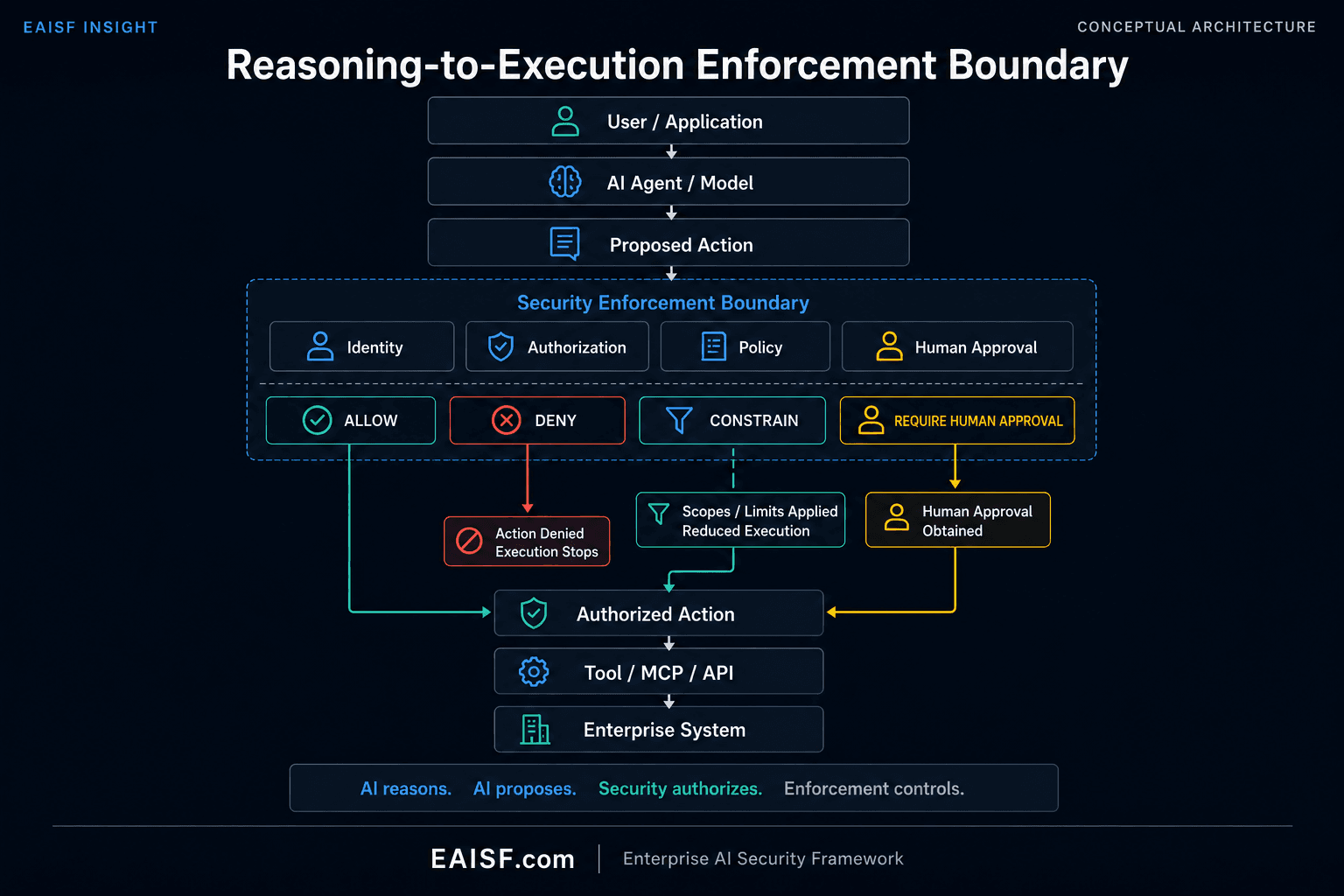
User request → Model reasoning → Proposed action → Security enforcement boundary → Authorized action → Enterprise execution
The model may propose what should happen.
The security architecture must determine what is actually permitted.
This reflects a foundational EAISF principle:
AI reasoning is not authorization.
Probabilistic reasoning may participate in deciding what action would be useful. It should not become the sole authority that permits a security-sensitive action.
Traditional security remains essential
Enterprise AI does not make IAM, Zero Trust, application security, API gateways, secrets management, network controls, data security, or monitoring obsolete.
Those controls remain essential.
The issue is that they may not answer the complete authorization question created by agent-mediated execution.
Authentication may establish:
Who initiated the request?
An API gateway may establish:
Is this caller permitted to invoke this API?
An agentic workflow may additionally require answers to questions such as:
Which agent is acting? Under whose authority? Which tool is being requested? Which operation is being attempted? Against which resource? Using which data? Within what scope? Does this action require additional approval?
The EAISF position is therefore not that traditional application security has failed.
It is that traditional security remains necessary but is not sufficient by itself for every AI-mediated decision and action.
A tool call is a proposal, not permission
This distinction becomes critical when an agent can invoke tools.
Suppose a model produces:
Tool: SendEmail
Recipient: external@example.com
Attachment: confidential-report.pdf
That tool call expresses what the model wants to do.
It does not establish that the action is authorized.
A separate security decision may need to consider:
the user identity, agent identity, delegated authority, destination, data classification, tool permission, operation scope, environment, policy, and approval state.
The safer execution model is:
Model proposes → Authorization evaluates → Policy decides → Enforcement occurs → Tool executes
Possible policy outcomes might include:
Allow, Deny, Allow with constraints, or Require human approval.
The important property is not whether the model was prompted correctly.
It is whether the proposed action encounters an independent enforcement boundary before execution.
What an AI Security Gateway actually is
The word gateway can imply a single appliance through which every AI transaction must pass.
That is not the intended architectural claim.
An AI Security Gateway is better understood as a logical security-enforcement pattern.
Depending on the enterprise architecture, the pattern might be implemented using:
an API-management platform, an AI-specific gateway, tool middleware, an MCP gateway, a policy-enforcement service, an agent control plane, downstream enforcement points, or a combination of these mechanisms.
The topology is secondary.
The security property is primary:
Security-sensitive AI actions must encounter enforceable controls outside the model before they reach protected enterprise capabilities.
The architecture matters more than the product name.
What the enforcement boundary may evaluate
A practical enforcement boundary can combine multiple forms of security context.
It may evaluate identity and delegation, tool permissions, requested operation, target resource, data classification, context provenance, policy constraints, transaction limits, human-approval requirements, and other relevant security state.
It may also coordinate supporting controls such as content inspection, rate limits, cost limits, response filtering, audit correlation, and observability.
But these functions do not all need to exist inside one physical gateway.
Trying to force identity, policy, DLP, tool execution, model routing, observability, approval, and every other AI-security function into a single central component can create its own availability, latency, scaling, and blast-radius problems.
The goal is complete mediation of sensitive actions, not centralization for its own sake.
MCP makes authorization more important, not less
Model Context Protocol is making tools and resources easier for AI systems to discover and invoke.
That improves interoperability.
But standardized connectivity does not imply standardized permission.
A client might discover that a tool exists without being authorized to use it.
A useful distinction is:
Tool discovery ≠ tool authorization
And similarly:
Tool connectivity ≠ permission to act
As enterprise agents gain access to larger ecosystems of tools, MCP servers, APIs, and external services, permission boundaries become increasingly important.
The ability to connect an AI system to a capability should remain separate from the authority to exercise that capability.
Prompt filtering is not the enforcement boundary
Prompt injection is an important AI-security problem.
Prompt and content classifiers can help identify suspicious instructions or untrusted influence.
But detection and enforcement have different responsibilities.
A classifier might conclude:
Prompt-injection likelihood: high
That is useful security evidence.
It is not equivalent to answering:
May this agent transfer confidential data outside the organization?
or:
May this agent delete a production resource?
Probabilistic security signals can inform policy.
They should not automatically become the sole authorization authority for sensitive operations.
A stronger architecture is:
Untrusted context → AI reasoning → Proposed action → Identity + authorization + policy → Enforcement → Enterprise capability
This has an important consequence.
Even if a prompt-injection detector fails, a compromised reasoning process still encounters an authorization boundary before reaching sensitive capabilities.
The security objective therefore becomes stronger than attempting to make prompt injection impossible.
It becomes:
Limit what compromised or mistaken reasoning is capable of doing.
The gateway must preserve identity and delegated authority
A gateway can become dangerous if every AI agent reaches enterprise systems through one highly privileged identity.
That would turn a security boundary into an authority concentrator.
The system should preserve enough identity and delegation context to determine:
who initiated the request, which agent is acting, which workload executes the action, what authority was delegated, which permissions apply, what scope is allowed, and when that authority expires.
This leads to an important design rule:
An AI Security Gateway should mediate, constrain, or contextualize authority—not silently aggregate it.
Least privilege applies not only to the human user.
It also applies to agents, tools, workloads, delegated permissions, data access, and the duration of authority.
High-impact actions may require human approval
Some actions deserve stronger controls than automated allow or deny.
Examples include:
sending confidential information externally, transferring money, deleting important records, modifying production infrastructure, changing identity permissions, or executing irreversible business operations.
For these operations, the execution path may become:
Model proposes → Policy identifies high impact → Human approves → Execution proceeds
Approval after the action is merely notification.
Meaningful human control must occur before the consequential operation.
Human approval should also not be applied indiscriminately to every tool call. Excessive approval requests create fatigue and eventually weaken the control.
Approval is most valuable when policy applies it selectively to genuinely high-impact or ambiguous actions.
Enforcement is more important than where the gateway sits
A common design question is:
Should the gateway sit before the model or after the model?
That framing is too narrow.
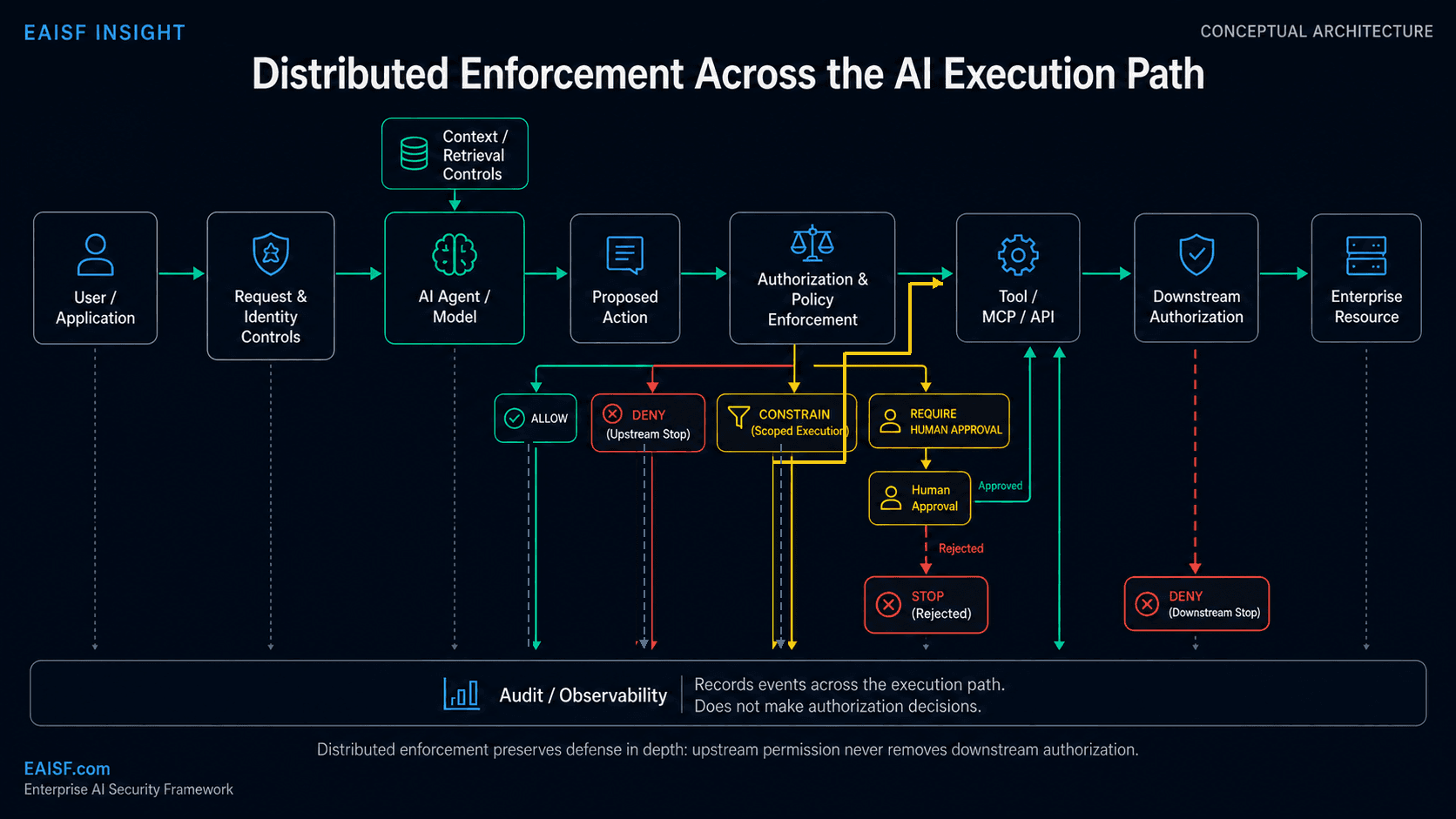
Different security controls belong at different points in the AI execution path.
Input and context controls may operate before inference.
Retrieval security may operate while constructing model context.
Authorization must occur before protected tools or resources execute sensitive operations.
Data-loss controls may operate before information leaves a trust boundary.
Audit and correlation should span the entire interaction.
The architecture may therefore look conceptually like:
User/Application → Request controls → Model/Agent → Proposed action → Authorization and policy enforcement → Tools/MCP/APIs → Enterprise systems
An AI Security Gateway should therefore not be understood only as a reverse proxy in front of an LLM.
The more useful concept is a coordinated enforcement boundary across the reasoning-to-action path.
AI Security Gateways and API Gateways are complementary
An API gateway continues to serve important conventional responsibilities:
authentication, transport security, routing, throttling, service exposure, protocol mediation, and API observability.
An AI Security Gateway addresses a different logical problem:
How does AI-generated intent become authorized enterprise execution?
The two may overlap technically.
An existing API-management platform may be able to implement significant portions of the AI-security boundary.
That is desirable when it can enforce the required security property.
EAISF should not encourage enterprises to duplicate infrastructure simply because AI is involved.
Reuse existing security technology where it can express and enforce the required policy.
Introduce new infrastructure only where existing controls cannot adequately represent or mediate the AI-specific execution path.
What the gateway should not become
An AI Security Gateway should not become a replacement for IAM, Zero Trust, application security, API security, secrets management, downstream authorization, or data-security controls.
It should not become a superuser through which agents inherit broad enterprise privilege.
It should not infer authorization solely from natural-language reasoning.
And it should not become a single enormous dependency whose failure disables every AI workload in the enterprise.
A strong design composes with existing security controls.
Where practical, the protected downstream resource should continue enforcing its own authorization as well.
The gateway adds another security boundary.
It does not eliminate defense in depth.
The EAISF perspective
Within EAISF, the AI Security Gateway is an architectural pattern.
It is not:
a security domain, a commercial product, the definition of EAISF, or a mandatory component for every architecture.
The underlying security principle is broader:
Probabilistic reasoning → Proposed intent → Enforceable security boundary → Authorized execution
The gateway is one way to implement that boundary.
This pattern intersects several existing EAISF principles:
AI reasoning is not authorization.
Probabilistic systems require enforceable boundaries.
Detection and enforcement are different.
Apply least privilege and least agency.
Identity and delegation must be explicit.
High-impact actions require stronger control.
Security-relevant AI actions must be attributable.
It also intersects multiple EAISF security domains, particularly Identity & Trust, Authorization & Delegation, Tool, MCP & Action Security, Context, Retrieval & Memory Security, Data Protection & Information Flow, Runtime Policy Enforcement & Human Control, and Observability, Audit & Incident Response.
The distinction matters:
Those are Framework concepts. The AI Security Gateway is an architecture pattern that may help implement some of them.
A useful architecture test
Instead of beginning with:
Do we have an AI Security Gateway?
ask:
Can model-generated intent reach a sensitive enterprise capability without encountering an independent authorization and enforcement boundary?
If the answer is yes, the architecture deserves closer examination.
The implementation might be a gateway.
It might be policy middleware.
It might be an agent control plane.
It might be enforcement distributed across tools and downstream systems.
The topology can vary.
The required security property remains:
AI reasons. AI proposes. Security authorizes. Enforcement controls. Only then does execution occur.
The objective is not to make the model perfectly trustworthy.
The objective is to prevent enterprise security from depending on it being perfectly trustworthy.
Practical takeaway
As enterprises move from copilots toward agents, the security question changes.
It is no longer enough to ask:
Can this user access the AI application?
Architects increasingly need to ask:
What authority reaches the agent?
Which capabilities can it invoke?
How is each action authorized?
Where is policy enforced?
Which actions require human approval?
Can the resulting execution be reconstructed later?
That is the architectural role of the AI Security Gateway pattern:
to create an enforceable boundary between AI-generated intent and enterprise action.